
🖼️ Types of Business Model Canvases: Complete Guide for Entrepreneurs
The document where we organize our business model is called a canvas. Because different types of businesses exist, different canvas proposals have emerged to address their specific needs.
Having identified our business type, it’s time to analyze the different types of canvases for business models to choose the most suitable one for your venture.
In this guide, we’ll analyze the three most common and useful canvases:
| Canvas | Ideal For |
|---|---|
| Staehler | SMEs and large companies with established teams |
| Osterwalder & Pigneur | All business types, operational focus |
| Lean | Startups, entrepreneurship, and innovation |
📊 Staehler Canvas
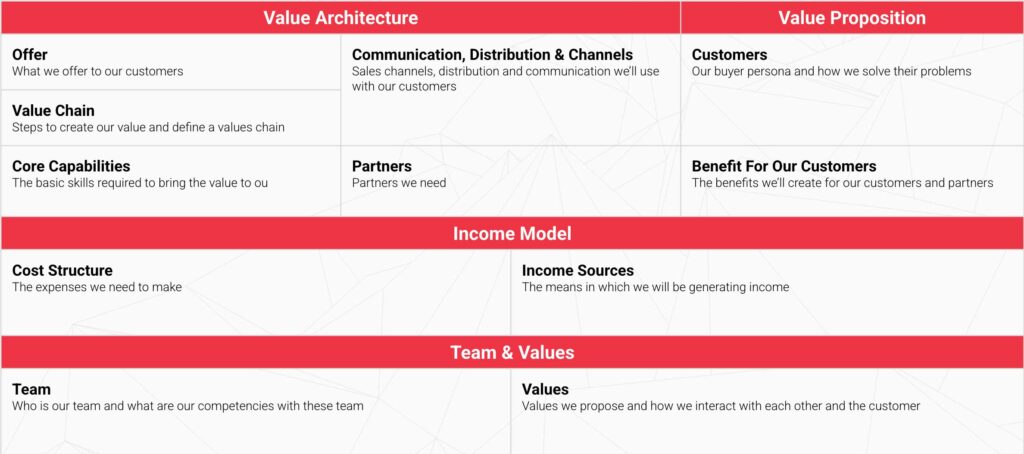
The first canvas, created by Patrick Staehler, proposes establishing a value architecture so that our offering delivers the promised benefits to our clients.
✅ Who Is It Ideal For?
Companies that have a work team, both SMEs and large enterprises. Its focus on value architecture makes it especially useful for established businesses seeking to clarify how they create and deliver value throughout their organization.
📋 Staehler Canvas Structure
The Staehler canvas is organized into four main areas:
1. Value Architecture
- Offering: What we offer to the market
- Value Chain: Steps to create our values and define a value chain
- Basic Capabilities: What we must possess to fulfill our offering
- Communication, Distribution, and Channels: Sales, distribution, and communication channels with customers
- Partners: Our key strategic partners
2. Value Proposition
- Customers: Our ideal buyer and how we solve their problems
- Customer Benefit: The benefits we create for customers and partners
3. Revenue Model
- Cost Structure: The expenses we need to incur
- Revenue Streams: The means by which we generate income
4. Team
- Members: The members of our team
- Values: How we project ourselves and communicate internally and externally
Download the Staehler Canvas
🎯 When to Use Staehler
- When your company already has a formed team
- For established businesses seeking to optimize their value architecture
- When you need to align team values with customer proposition
- Ideal for SMEs and large companies with defined structure
📊 Osterwalder & Pigneur Canvas
The proposal by Alexander Osterwalder & Yves Pigneur uses simpler language and focuses on improving our company’s functioning. It is, by far, the most popular and widely used canvas in the world.
✅ Who Is It Ideal For?
Implemented by SMEs and large companies alike. Its popularity stems from its simplicity and practical focus on daily operations.
📋 Osterwalder Canvas Structure
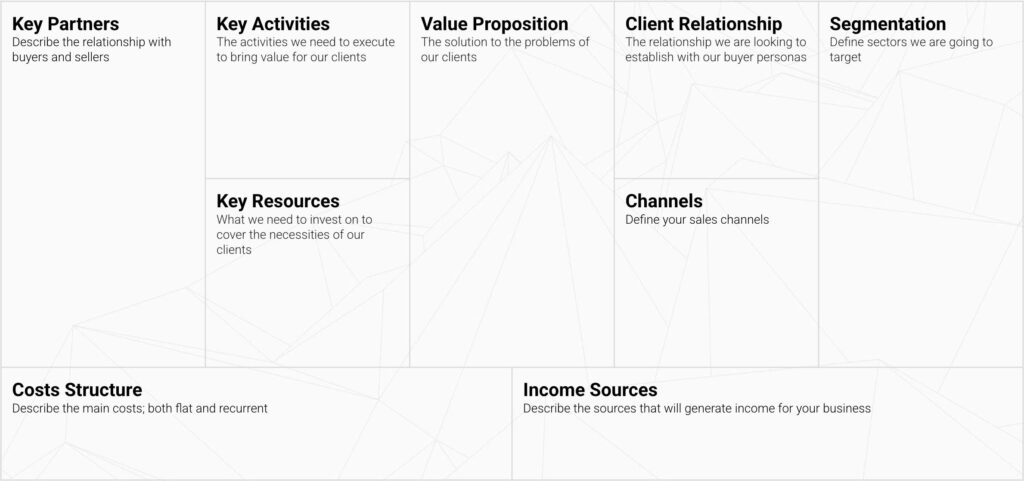
The Osterwalder canvas is divided into 9 fundamental blocks:
Right Side (Market Focus)
- Customer Segments: Who are our most important customers?
- Value Proposition: What problem do we solve for our customers?
- Channels: How do we reach our customer segments?
- Customer Relationships: What type of relationship does each segment expect?
Left Side (Operational Focus)
- Key Activities: What key activities does our value proposition require?
- Key Resources: What key resources does our value proposition require?
- Key Partners: Who are our key partners and suppliers?
Bottom Section (Financial Focus)
- Cost Structure: What are the most important costs in our business?
- Revenue Streams: How does our business generate revenue?
Download the Osterwalder Canvas
The 9 Blocks Explained
| Block | Key Question |
|---|---|
| Customer Segments | For whom are we creating value? |
| Value Proposition | What problem are we solving? |
| Channels | How do we reach our customers? |
| Customer Relationships | How do we interact with each segment? |
| Revenue Streams | What are customers willing to pay for? |
| Key Resources | What assets do we need? |
| Key Activities | What processes are essential? |
| Key Partners | Who are our strategic allies? |
| Cost Structure | What are our main costs? |
🎯 When to Use Osterwalder
- For most established businesses
- When you need a clear, simple view of your model
- Ideal for investor presentations
- To align the entire team in the same language
- Perfect for growing SMEs
📊 Lean Canvas
The Lean Canvas comes from the Lean Startup methodology and is an adaptation of the Osterwalder canvas proposed by Ash Maurya in 2010, specifically designed for startups.
✅ Who Is It Ideal For?
The Lean Startup methodology adapts very well to entrepreneurship and innovation. It focuses on solving problems in specific markets. Project managers and product teams prefer it. It also helps establish a competitive advantage.
📋 Lean Canvas Structure
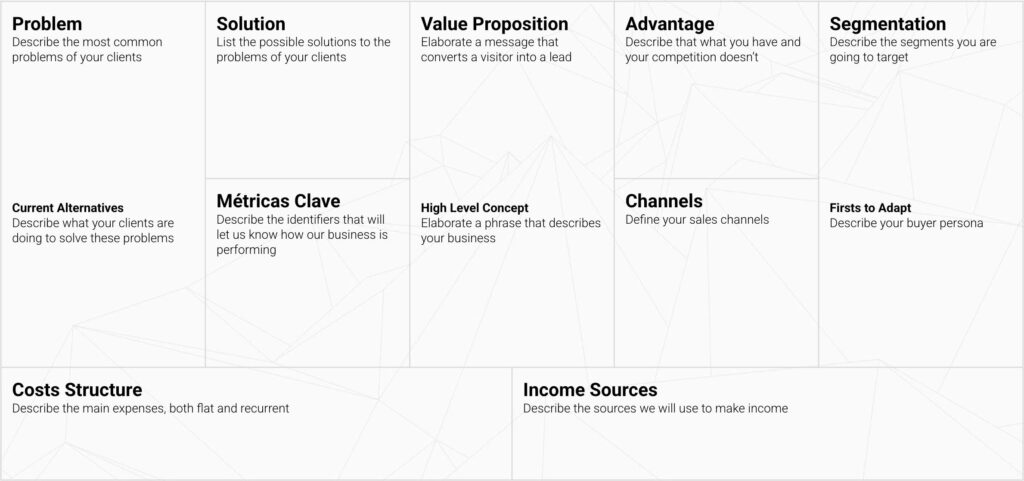
The Lean canvas modifies some blocks from the original to focus on problems, solutions, and the uncertainty inherent in startups:
Problem Focus
- Problem: The top 3 problems your target market faces
- Existing Alternatives: How are these problems solved today?
- Solution: How your company solves these problems
Customer Focus
- Customer Segments: Who are your target customers?
- Early Adopters: Your ideal first customers
- Value Proposition: The single, clear message that makes you different
Execution Focus
- Channels: How will you reach your customers?
- Key Metrics: What numbers will you measure?
- Unfair Advantage: What gives you a competitive edge?
Financial Focus
- Cost Structure: Your operating expenses
- Revenue Streams: How you generate income
Download the Lean Canvas
Key Differences in Lean Canvas
| Block | Difference from Osterwalder |
|---|---|
| Problem | Replaces “Key Partners.” Focused on customer pain points |
| Solution | Replaces “Key Activities.” Focused on how you solve |
| Key Metrics | New block to measure progress and success |
| Unfair Advantage | New block for competitive differentiation |
| Early Adopters | More specific than “Segments,” focused on first customers |
| Existing Alternatives | New block to understand current solutions |
🎯 When to Use Lean Canvas
- For startups and new ventures
- When solving a problem in a specific market
- If your business is based on innovation or technology
- For projects with high uncertainty needing rapid validation
- When seeking investment and need to show competitive advantage
- Ideal for project managers and product teams
📋 Comparative Table of Canvas Types
| Aspect | Staehler | Osterwalder | Lean |
|---|---|---|---|
| Focus | Value architecture | Business operations | Problem-solution |
| Ideal For | SMEs and large companies | All business types | Startups and innovation |
| Complexity | High | Medium | Medium |
| Number of Areas | 4 areas | 9 blocks | 9 blocks |
| Emphasis | Values and team | Relationships and resources | Problems and metrics |
| Popularity | Medium | Very high | High |
| Year Created | 2002 | 2008 | 2010 |
🎯 How to Choose the Right Canvas
To choose among the different types of canvases for business models, ask yourself these questions:
Diagnostic Questions
| If Your Answer Is… | Recommended Canvas |
|---|---|
| “We are an established company with a team” | Staehler |
| “I need simple operational clarity” | Osterwalder |
| “I’m starting with an innovative idea” | Lean |
| “I’m going to present to investors” | Osterwalder or Lean |
| “My business is technology-based” | Lean |
| “My business is traditional” | Osterwalder |
| “I want to align my team’s values” | Staehler |
You Don’t Have to Choose Just One
You can use different canvases at different stages of your business journey:
- Start with Lean Canvas to validate your problem and solution quickly
- Move to Osterwalder when you have clarity and need to operationalize your model
- Complement with Staehler when you have a team and need to align values and architecture
🚀 Conclusion
The types of canvases for business models are powerful tools that help you visualize, design, and communicate your business strategy. Each has its unique strengths:
- Staehler Canvas: For established companies with teams, focusing on value architecture and team alignment
- Osterwalder Canvas: The industry standard, simple and complete for most business types
- Lean Canvas: For startups needing to validate problems and solutions rapidly
Choose the one that best suits your current stage and business type. And remember: the canvas is not an end in itself—it’s a tool for thinking, communicating, and aligning your team around a shared vision.
Do you know which canvas you’ll use for your business?